Introduction to Responsible AI
Slides — Chapter 1
About the instructor

Dr. Fei Huang
Associate Professor, Risk and Actuarial Studies, UNSW Business School
feihuang@unsw.edu.au · feihuang.org
Her research and teaching focus on responsible AI, insurance, and data-driven decision-making that is accurate, interpretable, and equitable.
Course materials and assignments
- Lecture notes are published at responsible-ai.feihuang.org
- An assignment is issued after each lecture
- Many questions are open-ended, to accommodate the multidisciplinary nature of this class
- Expect roughly 2 hours to complete each assignment
- You will have 1 week to submit
Today’s roadmap
2-hour session, five parts, five discussion breaks
| Time | Part |
|---|---|
| 0:00 – 0:20 | Why Responsible AI? |
| 0:20 – 0:40 | Six principles of AI ethics |
| 0:40 – 1:05 | The ethical AI lifecycle |
| 1:05 – 1:15 | Break |
| 1:15 – 1:45 | Regulatory context |
| 1:45 – 2:00 | Course roadmap |
Learning objectives
By the end of this chapter, you should be able to:
Responsible AI: designing, deploying, and governing AI so that automated decisions are fair, explainable, and privacy-respecting, not just accurate.
- Explain why responsible AI matters for consequential automated decisions (decisions that meaningfully affect a person’s life)
- Describe six core AI ethics principles
- Outline a lifecycle view of ethical AI
- Identify key regulatory developments across jurisdictions
- Map fairness, explainability, and privacy to this course
Note
Insurance recurs as a worked example, but the principles apply to any consequential automated decision: hiring, lending, healthcare, criminal justice.
Part 1: Why Responsible AI?
The promise
- More accurate risk assessment and resource allocation
- Faster, more consistent screening of applications, claims, cases
- New data sources → finer-grained decisions
- Automation frees professionals for higher-value work
The problem
- Consequential decisions affecting access, pricing, and opportunity, all at scale
- Complexity obscures how decisions are made
- Data reflects historical patterns, including past discrimination
- Errors and biases scale automatically across large populations
Responsible AI is not about slowing innovation — it is about making innovation defensible.
Responsible AI is interdisciplinary
No single field is sufficient on its own:
- Domain expertise: what counts as a fair or reasonable outcome, in context
- Statistics and machine learning: the modelling and measurement tools
- Law: the binding obligations
- Economics: the trade-offs and incentives at stake
- Risk management: embedding it all into governance
It also needs collaboration across stakeholders: customer advocates, regulators, and industry practitioners, and across professions within a single firm: actuaries, data scientists, lawyers, risk officers, business leaders.
A failure is not always obvious
Illustrative example: hidden proxy discrimination
US insurers have used credit-based insurance scores since the early 1990s. The scores are genuinely predictive of claims cost.
A 2007 FTC study found the score is far from race-neutral. It placed over 25% of Black consumers in the lowest, most expensive score band, against 3% of white consumers (Kiviat 2019).
Removing race as an input wouldn’t have fixed this. Credit history already tracks it.
The same pattern recurs across sectors
Healthcare
A widely used US algorithm allocated care-management resources by predicted cost rather than predicted illness, systematically under-referring Black patients, who historically incurred lower costs for the same level of need (Obermeyer et al. 2019).
Hiring
Amazon scrapped an internal hiring tool after finding it penalised résumés containing the word “women’s,” a pattern learned from a decade of mostly male submissions (Dastin 2018).
Credit
Apple Card’s credit-limit algorithm drew a New York regulatory investigation after customers reported women receiving lower limits than their husbands despite similar finances, though the investigation found no fair-lending violation (New York State Department of Financial Services 2021).
China: e-commerce
Platforms charging loyal returning customers more than new customers for the same product, dàshùjù shāshú (“big data exploiting familiar customers”), became common enough to prompt an explicit ban in the 2022 Algorithm Recommendation Provisions (Cyberspace Administration of China 2022).
💬 Discuss
Think of an automated decision system you’ve encountered: a loan, a job application, an insurance quote, a hiring screen.
What data might it use as an unintentional proxy for a protected attribute (a characteristic like race, gender, or age that anti-discrimination law protects)?
Take a moment to think it through, then we’ll take a few answers.
Indicative answers: proxy attributes
Credit and lending
Postcode can proxy for race, a legacy of historical redlining. Employment gaps can proxy for gender, from career breaks tied to childcare.
Hiring
Graduation year can proxy for age. Specific résumé wording can proxy for gender, as with Amazon’s tool penalising “women’s.”
Insurance pricing
A credit-based score can proxy for race, as in this chapter’s own worked example. Vehicle engine size and mileage can proxy for gender and age, though each also carries genuine risk signal, which is what makes them harder to simply exclude.
“Proxy-ness” is a matter of degree, not a yes/no flag.
Part 2: Six Principles of AI Ethics
Six principles
- Fairness and non-discrimination: no unjustified disparate outcomes
- Transparency and explainability: interpretable to developers and affected parties
- Accountability: clear who is responsible when AI causes harm
- Privacy and data ethics: rights over collection, use, sharing, retention
- Contestability: meaningful channels to challenge and appeal
- Stability and robustness: reliable under drift, adversarial inputs, time
This course develops three of these six quantitatively: fairness, explainability, privacy. Reid Blackman calls this same trio AI’s “Big Three” ethical risks (Blackman 2022).
Three pillars
A similar cast of stakeholders recurs across all three pillars: the people affected by the decision, the regulators who oversee that domain, and the organisation deploying the system. What differs is the question each pillar asks.
| Pillar | Core question |
|---|---|
| Fairness | Does the model treat people equitably? |
| Explainability | Can decisions be understood and justified? |
| Privacy | Are personal data used appropriately? |
From principles to practice
How do we operationalise “fairness” or “explainability” in a way that is measurable, auditable, and defensible?
| Principle | Covered in |
|---|---|
| Fairness | Ch 2–3 |
| Explainability | Ch 4–5 |
| Privacy | Ch 6–7 |
| Accountability | Ch 2, 4, 8 |
| Contestability | Ch 2, 4–5 |
| Stability & robustness | Ch 8 |
💬 Discuss
Of the six principles, which do you think is hardest to turn into something measurable and auditable, and why?
Indicative answer: hardest to measure
Most commonly nominated: accountability and contestability
Accountability is an organisational-structure question (is responsibility clearly assigned?), not a property of the model, so it’s audited through process evidence rather than a statistical test. Contestability has no single metric either. It’s measured through process indicators like the share of contested decisions overturned.
Also defensible: stability and robustness
Drift and adversarial-robustness tests exist, but operationalising “reliable over time” needs ongoing monitoring infrastructure, not a one-off number.
Hard to measure doesn’t mean unimportant. It’s exactly why fairness, explainability, and privacy, which already have a mature quantitative toolkit, are this course’s three pillars.
Part 3: The Ethical AI Lifecycle
AI does not fail at deployment
“The most frequent failure in data analysis is mistaking the type of question being considered.” — Leek and Peng (2015)
A common source of AI failure lies in problem formulation, not the model: the wrong question, the wrong outcome variable, the wrong sense of who’s affected.
Ethical risk lives at every stage of the lifecycle, not just at deployment.
A six-stage lifecycle view
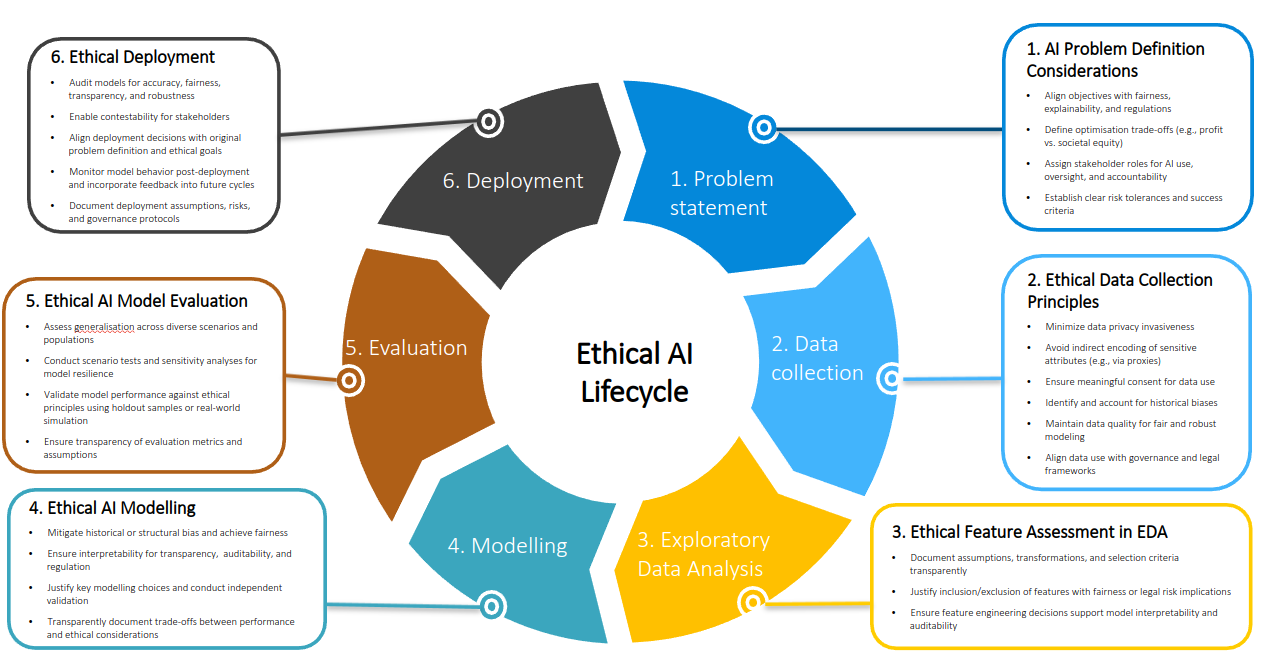
The ethical AI lifecycle. Source: Huang (2025).
A practitioner’s role
Domain professionals are increasingly involved at every stage, not just development and validation, but governance, risk assessment, stakeholder communication. Responsible AI is a professional obligation.
Six types of question
Leek and Peng (2015): most analysis failures come from answering the wrong type of question, not answering the right one badly.
| Type | Asks |
|---|---|
| Descriptive | What happened? |
| Exploratory | What patterns exist? |
| Inferential | What can we infer about a population from a sample? |
| Predictive | What is likely to happen? |
| Causal | Does X cause Y? |
| Mechanistic | How exactly does the system work? |
Descriptive vs exploratory: how would you tell these two apart?
Inferential vs predictive vs causal: how would you tell these three apart?
Causal vs mechanistic: how would you tell these two apart?
Mistaking a descriptive or exploratory pattern for a causal one is an ethical failure, not only a technical one. A pattern that reflects historical bias or a proxy for a protected attribute (postcode, gender) can get treated as if it justifies risk, laundering that bias into the model.
💬 Discuss
A consulting firm has two teams working for two different clients, each asked a predictive question.
Team A works for a major supermarket, forecasting stock demand. No individual is priced or screened based on the output.
Team B works for an auto insurer, predicting claims for individual policyholders, to set their premiums.
For each team, what should drive model class, feature selection, and evaluation criteria? Why might the same question type lead to different choices?
Take a moment to think it through, then we’ll take a few answers.
Discussion: same question, different stakes
Team A — retail demand forecasting
No individual is priced or screened, so accuracy is the dominant consideration. A complex, high-accuracy model is the right choice.
Team B — insurance pricing
Same question shape, applied to individuals, changes everything. Interpretability now matters as much as accuracy, feature selection needs scrutiny for proxies, and fairness metrics join the evaluation.
Break (10 min)
Part 4: Regulatory Context
A rapidly changing landscape
A jurisdiction-by-jurisdiction survey. Chapters 2, 4, and 6 develop the specific fairness, explainability, and privacy mechanisms in depth.
United States: sector-by-sector
No federal AI law. States and sector regulators lead:
- Colorado SB21-169 (2021) (Colorado General Assembly 2021): first US law on algorithmic discrimination in insurance
- NYC Local Law 144 (2021) (New York City Council 2021): independent bias audits for automated employment decision tools
- NY DFS (Department of Financial Services) Circular Letter No. 7 (2024) (New York State Department of Financial Services 2024): bias testing, governance, explainability to consumers
- CFPB and ECOA (2023) (Consumer Financial Protection Bureau 2023): adverse-action notice duty (the duty to tell a rejected applicant why) applies to AI-driven credit decisions
European Union: horizontal regulation
EU AI Act (2024) (European Parliament and Council of the European Union 2024): risk-based, applies across sectors.
High-risk (Annex III) includes life and health insurance risk assessment and pricing, employment, credit, education, law enforcement:
- Conformity assessment (a formal check that a system meets legal requirements) before deployment
- Mandatory risk management + data governance
- Transparency, documentation, human oversight
- Post-market monitoring
Australia: principles-based, multi-regulator
No standalone AI Act, existing sector laws apply, enforced in parallel by regulators such as ASIC (the Australian Securities and Investments Commission). The absence of a new AI law does not mean an absence of accountability.
Important
Obligations don’t transfer to a vendor. If a third-party model produces unfair outcomes, the regulator looks to the deploying organisation (Parra-Orlandoni and Carvão 2026).
Australia is not the EU
| EU AI Act | Australia (2026) | |
|---|---|---|
| Legislation | Standalone AI-specific Act | No standalone AI Act (yet) |
| Coverage | Mandatory “high-risk” category | Existing laws apply to AI |
| Regulator | Single AI regulator | Multi-regulator (ASIC, APRA, OAIC…) |
| Enforcement | Prohibitions and fines | Standards-led, risk-based |
No new AI law ≠ no accountability. The regulators are already watching.
Case Study: ASIC REP 798
A governance failure
A licensee deployed an AI credit-default model, no AI strategy, no policies, no risk rating. Review ten months in found “limited understanding” of the third-party platform, “incomplete model documentation,” “poor governance.” Described as a “black box.” The licensee kept using it for months more.
Source: ASIC Report 798 (Oct 2024) (Australian Securities and Investments Commission 2024)
At what point does continuing to use a system you can’t explain stop being an operational gap and become an ethical failure?
The trust gap
Australia has the lowest AI trust of any country surveyed
- 30% of Australians believe AI’s benefits outweigh its risks — the lowest of any country in the study
- 78% are concerned about negative outcomes from AI
- 30% think current safeguards and regulation are adequate
Source: KPMG & University of Melbourne, Trust, Attitudes and Use of AI: A Global Study 2025 (KPMG and University of Melbourne 2025)
This is the public REP 798 is written for. A governance failure like the one on the previous slide is exactly what erodes the 30% further.
Australia: what’s coming
| Timing | Development |
|---|---|
| Oct 2025 | AI6 guidance released (Ch 8) |
| Dec 2025 | National AI Plan, mandatory guardrails shelved |
| Early 2026 | AI Safety Institute launched |
| Dec 2026 | Privacy Act ADM disclosure mandatory |
China: binding, sector-specific
No comprehensive AI law yet, though the State Council’s 2026 Legislative Work Plan calls for “accelerating comprehensive legislation” (General Office of the State Council of the People’s Republic of China 2026). Sector rules cover most consequential use:
- NFRA (National Financial Regulatory Administration) Guidance on AI in Banking & Insurance (2026) (National Financial Regulatory Administration (China) 2026): applies directly to banking and insurance institutions
- PIPL (Personal Information Protection Law) Article 24 (2021) (National People’s Congress (China) 2021): transparency, fair results, right to explanation (the ability to ask why an automated decision was made)
- Algorithm Recommendation Provisions (2022) (Cyberspace Administration of China 2022): bans “big data price discrimination” (charging a customer a worse price using their own data) where it applies
Singapore: voluntary, principles-based
- Model AI Governance Framework (2019, updated 2020) (Personal Data Protection Commission Singapore and Infocomm Media Development Authority 2020): extended for GenAI (2024) and Agentic AI (2026)
- AI Verify (AI Verify Foundation 2023): open-source governance testing toolkit
- MAS (Monetary Authority of Singapore) FEAT (Fairness, Ethics, Accountability, Transparency) Principles (Monetary Authority of Singapore 2018) + Veritas Initiative (Monetary Authority of Singapore 2019): financial-sector fairness methodology
Note
FEAT/Veritas ask how to define, measure, justify, monitor fairness, the financial-sector counterpart to Chapter 2’s criteria, developed independently by a regulator.
Common themes across jurisdictions
- Governance and accountability
- Fairness testing and bias assessment
- Explainability and transparency
- Privacy and data protection
💬 Discuss
If you were designing AI regulation from scratch, the EU’s single comprehensive law, or the US/Australia’s sector-by-sector approach?
What’s the trade-off?
Indicative answer: regulatory design trade-off
Comprehensive law (EU)
Consistent definitions and obligations across sectors and member states, less regulatory arbitrage, one compliance standard for multinational firms. Costs: slow to negotiate, risks being too generic for sector-specific nuance, harder to amend as the technology moves.
Sector-by-sector (US/Australia)
Faster to respond to a specific, visible harm, such as NYC’s bias-audit law following hiring-tool harms directly. Rules fit existing sector regulators. Costs: gaps and inconsistency across sectors and states, and a tendency to regulate fastest where harm is most visible, leaving newer applications under-regulated until something goes wrong.
The trade-off: consistency and predictability vs speed and tailoring. Australia’s mix of existing sector law plus emerging cross-cutting guidance is itself a middle path between the two extremes.
Part 5: Course Roadmap
Structure: principles and practice
| Ch | Title | Focus |
|---|---|---|
| 2 | Fairness Principles | Criteria, model designs |
| 3 | Fairness Practice | French motor insurance (R) |
| 4 | Explainability Principles | PFI, PDP, ALE, SHAP, LIME |
| 5 | Explainability Practice | XGBoost insurance model (Python) |
| 6 | Privacy Principles | k-Anonymity, DP, synthetic data |
| 7 | Privacy Practice | Insurance micro-data (R) |
| 8 | Trade-offs & Integration | Systemic risk, governance |
Case Study: COMPAS
COMPAS recidivism scoring
ProPublica’s 2016 Machine Bias investigation (Angwin et al. 2016) found that among defendants who did not reoffend, Black defendants were flagged “high risk” at nearly twice the rate of white defendants. The vendor countered COMPAS was well-calibrated, same reoffense rate within each score band, across race.
Both sides had a point. A tool can be calibrated (sufficiency) and still violate error-rate parity (separation). Chapters 2–3 give you this vocabulary.
Case Study: UK A-level algorithm
Ofqual’s 2020 grading algorithm
COVID cancelled exams. An algorithm converted teacher predictions into final grades (Centre for Multilevel Modelling, University of Bristol 2020), downgrading ~40%, leaning on each school’s history, so state-school students were downgraded more than students at small, historically high-performing private schools.
No one could get “why this grade?” answered before results day. Public backlash, including the Prime Minister calling it a “mutant algorithm,” forced a reversal within days. Chapters 4–5 cover the tools that could have quantified this beforehand.
Case Study: Cambridge Analytica
Cambridge Analytica (2018)
Data on ~87M Facebook users, collected via a “personality quiz” under the guise of research, repurposed for political micro-targeting without consent. FTC (the U.S. Federal Trade Commission) fined Facebook $5B (Federal Trade Commission 2019).
Not a breach, but a repurposing. Data collected for one purpose, used for another. Chapters 6–7 cover this exact boundary.
A quantitative course
By the end, you should be able to:
- Fit and compare fairness-aware models and quantify the trade-off
- Interpret complex models with state-of-the-art explanation tools
- Assess and reduce re-identification risk
- Generate and evaluate synthetic data
- Communicate technical results to non-technical stakeholders
Connecting the pillars
Illustrative example: the telematics insurer
GPS + accelerometer data → distance, time of day, speeding, acceleration, braking.
- Fairness: proxies for age, gender, socioeconomic status?
- Explainability: can the insurer explain which factors drove the premium (the price paid for coverage)?
- Privacy: legal basis for continuous location data? Third-party sharing? Deletion rights?
💬 Discuss: wrap-up
Of the three case studies today (COMPAS, UK A-levels, Cambridge Analytica), which failure would be hardest to fix with a purely technical solution, and why?
Indicative answers: which failure is hardest to fix
COMPAS
Has a real technical dimension, the calibration-vs-error-rate-parity impossibility result from Chapters 2–3, but is ultimately a policy choice about which fairness criterion to prioritise when base rates differ. Better modelling alone can’t resolve that.
UK A-level algorithm
Arguably the most technically fixable: the failure was a lack of transparency and no tested appeal channel before results day, both addressable with Chapters 4–5 tools.
Cambridge Analytica
The hardest to fix technically. A consent and purpose-limitation failure, not a modelling error, so no technical safeguard fixes it. It needs legal and organisational controls instead.
Most real failures need technical tools combined with governance and policy choices. That’s exactly Chapter 8’s theme.
Recommended reading
- Huang (2025): ethical AI lifecycle framework
- Barocas and Selbst (2016): legal/technical treatment of disparate impact
Chapters 2–7 each have their own reading list.
Next class
Chapter 2: Fairness Principles
Bring one example (from any domain) of a decision you think might be unfair, and why.